Showing posts with label Reviewer: Crisetta MacLeod. Show all posts

Wednesday, February 23, 2011

Book Review | Diamond Eyes by A.A. Bell

Harper Voyager

Into the life of a strange, demented, violent woman, cruelly constrained in an asylum, comes a new therapist with his own issues. Ben is the first person to get through to Mira. He begins to probe the dissociated world that she lives in; she is blind, but seems to see, and has extraordinary multi-faceted reflective eyes. As he begins to draw her out, he takes her back to visit the strange tree-home where she was raised. Meanwhile, two scientists are working on an infallible lie-detector using physiological and psychological input.
These two, in cahoots with Ben, begin to unravel just what it is that Mira ‘sees’. Then someone is murdered… Mira was not physically present, but she ‘saw’ what happened! Wild cross-country chases, layers of authority where the corrupt and the well-meaning are indistinguishable, and a lovable mischief-making asylum inmate whose deafness is a counterpoint to Mira’s blindness. What a rare and special tale! A. A. Bell has that much beloved faculty of good science fiction writers—she takes areas of science that are already understood, and squeezes them just a bit further so that the scientific basis of her story has a grounding in fact.
This review first appeared in the Aurealis Magazine subscriber newsletter.

Thursday, October 21, 2010

Book Review | Tymon’s Flight by Mary Victoria


Review by Crisetta MacLeod

I caught up with Voyager’s new kid on the block at Aussiecon4 in Melbourne. She told me her background was in animation. She worked on Lord of the Rings, which is what took her to New Zealand, where she has lived for ten years after travelling the world ceaselessly. Her family is Iranian, Jewish and English, and her husband is French. They have a cute little four-year-old daughter who was wearing very covetworthy pink boots. Her husband designed the evocative cover, showing a quaint flying machine in the tree canopy.
Tymon’s story is based in Mary’s tree world–the canopy of the tree is as large as the Himalayan mountain range. We talked about Avatar, and I told her about Kaaron Warren’s Walking the Tree, but Mary Victoria’s tree world was originally based on Iggdrasyl, the Norse legendary tree which encompasses the world. Tymon the protagonist is a rebellious orphan, raised in a Seminary. (Mary doesn’t apologise for her use of familiar tropes!) On completing his studies he is sent to a distant part of the canopy, as assistant to a dissolute missionary. It is there that he meets with the people who have been used as cheap labour by his original masters.
One of them is ritually sacrificed annually to the tree by being thrown off into the swirling cloud-filled depths below. After getting to know the locals, Tymon becomes disaffected from his origins, and joins forces with the oppressed peoples. To tell more is to spoil the story!
Mary scrapped the first version of her book, and then rewrote it entirely from scratch. Her second volume is due out in February, so we don’t have to wait long to find out what happens next.
This review first appeared in the Aurealis Magazine subscriber newsletter.

Tuesday, October 19, 2010

Book Review | Path of the Stray by Kim Falconer


Review by Crisetta MacLeod

The prologue leads us from a familiar Falconer scene into the first book of a new trilogy. In an austere and deteriorating world, autocratically ruled, Luka is working with cryogenically preserved DNA to drag wolves back from extinction. He links up with Janis and her daughter Loni, witches both. Janis is working on nanotechnology and when combined with Luka’s research…but I’ve said enough, the story will be spoiled. Suffice to say that the werewolf results of their combined efforts are spirited away to a parallel world which is free of pollution and oppression. One baby wolf is lost in the transition, and as an abandoned and resentful orphan becomes a cruel oppressor. Falconer peppers her story with astrological references, as we have come to expect from her. She also uses another Falconer trope, in that the two worlds between which her characters travel have differences in elapsed time.
An engrossing read demanding full engagement from the reader.

This review first appeared in the Aurealis Magazine subscriber newsletter.
Wednesday, August 25, 2010

Jatta by Jenny Hale

Review by Crisetta MacLeod

Here be dragons! This is a great tale in the best of fantasy traditions, but Jatta is a heroine with a severe monthly problem—she has been cursed, and on the full moon becomes a werewolf. Her father the king and her brother Arthmael seek to protect her as she horrifies all around them with her bloodlust and ferocious strength. The kingdom is also threatened by a tyrant who comes marauding through a magical portal. Jatta and Arthmael set forth on a quest to save the kingdom, and cure Jatta of her curse. With the aid of a magical object and loads of courage and perseverance… but I musn’t spoil the story! Just imagine wakening to find yourself covered in blood, with your bedroom destroyed, and your beloved brother horribly wounded—then imagine what it felt like to discover gradually that this bloody mayhem was all your own doing! This is a wonderfully imagined situation, and you will find Jatta’s doggedly faithful brother to be a likeable character indeed. So often the story seemed to be about to end in tragedy, and then…

Tuesday, August 17, 2010

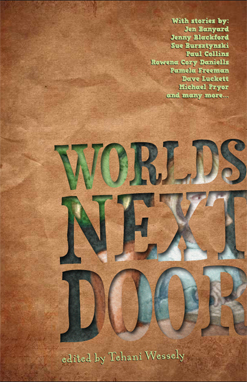
Book Review: Worlds Next Door edited by Tehani Wessely


Review by Crisetta MacLeod
This is a completely satisfying, wonderful collection. Whimsical, scary, funny, poignant stories, these could be read and enjoyed by any age group. And where’s the sex and gore that we think we need for modern fantasy? Entirely absent. Congratulations to all concerned, and especially Tehani Wessely, who brought about this very special state-of-the-art collection.
Meet a were-snail and feral frankenbooks. Find out what horrifies monsters. Laugh at demon ducks. Weep for exploitation of the love of a dog for his master, cry for a faithful neglected goat. There are lesson plans for classroom application on a website; similar material could be used for discussion in book clubs. Twenty five stories, all different, from hard-core scifi to only-just-speculative fantasy. This is a fine example of the small press anthologies that are becoming a feature of the Australian fantasy community, bringing sheer enjoyment to readers and creating a platform for our short-story writers, new and old. Onya, Tehani!
* This review appeared in the aurealisXpress newsletter for August 2010

Monday, June 28, 2010

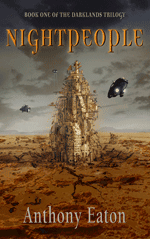
Book Review: The Darklands Trilogy: Nightpeople, Skyfall and Daywards by Anthony Eaton

This trilogy paints an evocative picture of post-apocalyptic Australia, a thousand years from now. Two populations are clinging to survival. The first group—the Darklanders—live by hunting and foraging in contaminated land enclosed by a huge black wall, and are guided by gifted Dreamers who can communicate by ‘reaching’ magically to the Earth Mother. The second group of survivors, the Skypeople or Nightpeople, live in an artificial, cocooned technological environment; upper classes live in luxury while an underclass serves them and lives in squalor.
It has become clear that neither society is ultimately viable, and it will take co-operation between the groups for humanity to survive. The Darklands people have mutated and adapted, but live very primitively, and have only a tiny population with a limited gene pool, whereas the Skypeople have extremely sophisticated technology and medical knowledge, but have not evolved at all. Their artificial society has become unstable both because of entropy to the aging fabric of the physical environment, and social entropy tearing their unstable society apart. They seek to understand the genetic makeup of the Darklands people, to enhance the genetic pool available and perhaps isolate the genes that make people ‘viable’ out of doors in the fierce, contaminated climate.
The first volume introduces us to Saria, who may be the last viable baby born to the Darklanders. The second centres on Lari, a disaffected son of the upper class in the tech city. Thus the author gives us an intimate picture of the deserts and forests of the primitive tribe, and by contrast, the doomed technology-dependent city society.
Saria and Lari team up, and with others from both environments form the Clan who are the focal group in Volume Three, Daywards. Children from the next generation—Dara and her twin brother Jaran, with their cousin Eyna—are now the chief protagonists. There is an ongoing social and political struggle in the Clan—is it betrayal to co-operate with the remnants of the tech civilisation, or is it expediency for the survival of them all? I found this third volume the least convincing, as Clan members variously tricked each other, betrayed their group, sulked, and resorted to Earth Magic inconsistently, while the aged Saria of Volume One wisely oversaw their doings. To say any more would be to spoil the story for readers. In spite of my misgivings about the ultimate resolution of it all, I found this trilogy to be an engrossing and wonderfully imagined exploration of a highly credible Australian future.


Review by Crisetta MacLeod